This is primarily intended as a resource for the A2 exam question on MEDIA + COLLECTIVE IDENTITY. There is considerable material on the British Cinema blog which is also relevant. As always, your comments and suggestions of useful resources are always welcome.
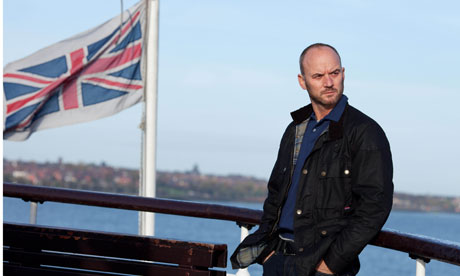
Paul Laverty in the Ken Loach film Route Irish. Photograph: Joss Barratt
The 11th-hour decision to sneak Ken Loach's latest film, a politically explosive thriller about contractors working in Iraq, into the running for the Palme d'Or was taken to ensure that its uncompromising argument is heard, according to producer Rebecca O'Brien.
Speaking for the first time before the premiere of Route Irish on Thursday, O'Brien said that she and Loach wanted to "find the best forum". "We just suddenly felt, here is a film that is really serious and that packs a very powerful political punch," she said. "Cannes is a place where people will take a work seriously and understand the politics."
The title of the film is taken from the nickname of the dangerous road that links Baghdad's safe green zone to its airport. The movie examines the difficulties experienced by ex-servicemen who cannot get used to living as civilians, and who often decide to go back to Iraq to work as commercial contractors. "The film asks what are we doing being involved in a privatised war? That is the real message, although we have dressed it around a thriller," said O'Brien.
The recent relaunch of The Guardian's sister paper, the Sunday Observer, drew a lot of comments from readers fed up with what they saw as the irrelevant London-centric focus of much of our national press, and the patronising tone which put many from outside the metropolitan bubble off this and other papers. The BBC has recognised its own deficiencies in this area, and has started moving major sections of the BBC beyond London, for example Radio5 is to move to Salford (Manchester). Any of the following quotes would be useful to demonstrate this point on the press:
[from Daily Telegraph readers: http://www.telegraph.co.uk/finance/newsbysector/mediatechnologyandtelecoms/5968035/The-Guardians-loyalty-to-the-Observer-looks-paper-thin.html]
The Guardian, like many other London papers, lost touch with its readers long ago. Metrocentrics are a major hazard in the media nowadays because they are openly contemptuous of those who keep them afloat - namely, the good people 'out there' in the regions, whose attention has now been diverted elsewhere. [J T McTurk]
This is the problem - a metropolitan elite, writing to itself, funded by a public sector slush fund (the job ads), and, on their astonishing salaries, entirely out of touch with the people they claim to represent. [FrankFisher]
There are several posts on this in the BritCinema blog, which is packed full of posts useful for this exam. Thought it might be useful to post the film's opening, which contains the crucial montage with the various scenes of flg-waving, and other images of nationalism, ultimately portrayed negatively through the editing of the montage.
TO SUM UP THE OPENING MONTAGE:
Meadows can be seen to explicitly reject the British identity, presenting it as a hegemonic ploy by a ruling elite (in this case, Thatcher) to disguise or cover-up inequalities. We see the flag being waved by the crowd celebrating the wedding of Prince Charles + Diana; being worn as a cape by young skinheads; being carried in the Falklands by British soldiers; being carried by a group of National Front (80s equivalent of BNP) marchers, with scenes of destruction and mayhem intercut: bombs exploding, striking miners being attacked by police, rioters in Northern Ireland etc. Repeatedly throughout this montage we get shots of Thatcher, who used the flag and the identity as part of her nationalist stance. The editing leaves the clear impression that the Union Jack is wielded by the cynical (politicians), deluded (the crowd celebrating what turned out to be a virtual sham royal wedding), and racist (NF marchers); the only real polysemic image is of the three boys draped in the flag, but with their backs turned. The film in many ways is the story such boys, and their journey of discovery with their identity. Meadows’ young protagonist, Sean, having literally draped himself in the (English) flag, stolen from an NF meeting, eventually comes to see it as an empty symbol, and throws it into the sea in the final scenes.
This is difficult, abstract stuff but I'd like you to have a go at reading up on the work of Anthony Giddens and summarising the main features.
We will discuss what these are, and how you might apply these ideas to the question on Media and Collective Identity. His ideas on globalisation and localism are useful, but its especially his theories on identity, and his use of the concept of narrative, which we will focus on.
You can choose from a number of resources on this (or try googling anthony giddens + additional terms):
http://www.guardian.co.uk/profile/anthonygiddens Various Guardian articles - Giddens is associated with the 'third way' political philosophy that saw Tony Blair try to merge right- and left-wing thinking in New Labour
With summaries on a number of useful theories and theorists on the general topic of identity, some of which we'll focus on in more detail: http://www.theory.org.uk/ctr-iden.htm
Lengthy article here about the current wave of 80s movie remakes and even movie versions of classic 80s TV shows such as The A-Team. A central point - one I've long argued is true - is that our media, and the trends they at least 'help' create are strongly tied to the age of the media executives and creatives and whichever era they look back on as their golden age. The 80s has long been an era ridiculed for awful music, fashion and film...and yet here we are with the charts packed with artists mimicking the 80s style and this spate of 80s remakes, not to mention shows like Ashes to Ashes (and, of course, films like Son of Rambow and This is England).
The noughties, the deacde most of you will look back on with a haze of nostalgia, will probably experience its own surge of cultural cool and reclamation in another 20-30 years when your generation dominate the media!
One particular paragraph stands out (I'll add the entire article below as the Murdoch press are soon to put firewalls up for their online content) in the context of this question of identity formation:
Nostalgia for the Eighties, in other words, is practically hard-wired into our contemporary culture. But it’s more than that, says Peter York, the author, broadcaster and doyen of all things Eighties (see the six-part TV series Peter York’s Eighties). “The allure of the Eighties is partially because they are like a more innocent version of now,” he says, noting in passing that he can’t wait to see the new Wall Street movie. “The Eighties have got some of the characteristics of the age we’ve just emerged from, which we now know was wicked, and all crumbled to dust. But also, in the Eighties we didn’t fear imminent destruction, we didn’t have a full-on clash of civilisation, and nobody fretted about the environment. So things could only get better.” He adds, tellingly, and almost wistfully: “The Eighties were the last time when the recognisable world was all in place. After the Eighties you looked at something and thought: ‘Is it real, or is it virtual?’ ”
Is there a desire to revert back to times before postmodernism and the rise of cyberspace made identity a blurred, problematic concept hard to pin down? Does this help explain the appeal of TisEng, Son of Rambow?
Interesting article here on the Ricky gervais Britflick Cemetery Junction; here's an excerpt which may help you think about yourselves as British filmmakers yourselves. This is a brief excerpt:
Our cinema doesn't depend on lavish, feelgood reassurance; it revels in seedy grittiness. That's the way we like it. We're not a nation of optimists who're certain we'll be redeemed. We're glum and suspicious. We quite like misery and are more at home with grunge than glitz.
Some interesting reader comments follow too, e.g. this:
It's interesting the feelgood romantic comedies that characteristed British cinema since the 1990s - Four Weddings, Notting Hill, Bridget Jones, Love Actually and the like - have disappeared. Even Richard Curtis's last film - The Boat That Rocked - was set in the 1960s Ditto Cemetery Junction takes place in 1973. For British filmmakers, we can feelgood about the past but not the present. Too many recent British movies - Fish Tank, Harry Brown, Eden Lake - present a thoroughly grim and despairing vision of the country. The odd exception was Mike Leigh's 'Happy Go Lucky'.
It's interesting that 'Four Weddings' opened in Britain in May 1994, on the very week John Smith died and Tony Blair emerged as the future leader of New Labour. There were a lot of parallels between Hugh Grant in that movie and Blair. Now, we have 'The Ghost' opening in the last days of the New Labour government - almost like a final nail being hammered in the coffin.
I often think that anyone who lived through the 1970s wouldn't want to return there. Films like 'Bloody Sunday', 'The Damned United', 'Control' and the 1974 segment of 'Red Riding' capture the grimness perfectly. Strikes, the Troubles in Ulster, football hooliganism, police corruption, drab provincial cities and raging inflation (just try going through newspapers of the period and you'll see how expensive everything was). It wasn't all bad, but on the whole I do prefer now.
I am always touched that people from overseas want to associate romance with us despite our appalling dentistry and somewhat random attempts at hygiene. The popularity of the Romcom may also go some way to making up for a number of our other recent exports to the world including drunkenness on an industrial scale, armed conflict, and the hairstyles of the 1970?s, which if my recent experience is to be believed, are still a regular fashion feature in a number of East German towns.
...
The Romcom is a universal scream of hope that one day things will get better. It is a hope that the future is not all gurning politicans, old age, death and taxes.
I've discussed the partisan nature of the UK national daily press on many occasions; here's a useful table showing the history of some of these over recent years:
It has been a useful device for clarifying some aspects of the exam, though progress has stalled somewhat as we've attempted to address the slippery concept of postmodernism, an especially useful concept for Q1b, but also the future element of Section B.
I have been keeping scores as we go, and it remains possible for any team to win at this point. Even if we don't get through it all, we'll complete this in the 1st lesson post-break, and winners will be duly announced. The offer of a substantive prize remains (just about) intact.
I'll post a blog-only optional round over the break, for emailed responses.
I'll also post details on the post-it note film over the break, including a prepatory task to complete before we return.
Take anyone else's AS or A2 coursework and prepare to explain to the class (in 60secs) in what ways this text is - maybe also is not - a postmodern text. Try to ground your argument in the theory you have read (use the blog if stuck), and think about the assessment criteria as you work on this.
You may wish to ground this in one of the 5 topics covered by Q1b.
You can do this purely verbally or with a brief slideshow, utilising still images.
You can now find copies of the OCR A2 Media Studies book in the Library.
There's no money left at the moment (unless we sell the last few copies of your AS coursework DVD!!!) to buy this, but you may want to consider purchasing Dan Laughey's Key Themes in Media Theory (2007), which provides an accessible overview of many of the theories you'll want to apply to both sections of the exam. Amazon link
You can read an excerpt at the Amazon page
I'll shortly add some links to resources. 13D have to Weds to create more detailed presentations on the theories of postmodernism and hegemony, incuding analysis of relevant examples. 13A have until Tues to do the same. In both cases, email the file to me (make sure its a .ppt file).
I'd like to largely wrap up the quiz on Thurs, though may add an individual test to finish up on 1st day back, with the average of the best and lowest scores within a group being the final additions to the group totals.
I will try to post instructions for the post-it note films we'll do in week back, look out for that
A reminder of the task as stated:
You now have exactly TEN minutes to research two theories, aiming for a 2-3min presentation to follow (use presentation software if you wish). Begin your presentation with an outline of HEGEMONY, and illustrate how this applies to Media, then move on to the theory of POSTMODERNISM, providing examples of postmodern media texts, and trying to explain why postmodernism is attacked by many Media theorists. 10 points for any team that gets a thumbs up from a majority; 5 bonus for the team considered the best 3 bonus points if you name any of the eg’s of pomo texts I’ll give on the next slide, including a genre-defining movie by a director with divine initials
A PowerPoint on the exam (Section B) and postmodernism
The following notes are based on the relevant chapter in Dan Laughey's Key Themes in Media Theory, a very useful book as regards the exam...
The concept of postmodernism denies definition to some extent, but Dominic Strinati outlined 5 key characteristics in 1995 that are often cited:
Breakdown of the distinction between culture and society
An emphasis on style over substance
Breakdown of the distinction between high art and popular culture
Confusions over time and space
Decline of metanarratives ['grand theories such as Marxism, Christianity and ... modernism have lost their currency for modern societies']*
*quoted from pp. 147-148
Jean Baudrillard and Simulcra
Baudrillard is famed for the notorious argument that the Gulf War did not happen, labelling coverage of it an example of hyperreality, or a simulcra:
The Gulf War did not take place, according to Baudrillard, because it was won by the mighty US Air Force before it had begun. The lasting memories of this war for most people were screened images - transmitted via military operations to CNN and other western media - showing how US pilots pinpointed and then bombed Iraqi targets (...) from thousands of miles above land. As such, 'This war is conducted according to the media model: war as a technological relationship ... founded on the abolition of symbolic exchange and the simulation of real communication' (Merrin 2005: 84). This is not a war in the sense of prolonged combat and conflict (the first two world wars, by contrast, really did take place); instead, we experience a virtual war, much like a video game simulates real warfare, and therefore this real-time, media-saturated spectacle is nothing other than what Baudrillard calls a 'non-event'. Subsequent wars in Afghanistan and Iraq amount to 'a rehash of the past, with the same deluge of military forces, bogus information, senseless bombardment, emotive and deceitful language, technological deployment and brainwashing. Like the Gulf War: a non-event, an event that does take place' (Baudrillard 2002: 34). [Laughey, 2007: 151]
Thought you might want an update on the scores - remember, there's 1 prize across the 2 classes (assuming I'm not given good reason to withdraw the prize!), a choice of the following DVD boxsets:
Both classes are now at the same point: presentations on the concepts of hegemony and postmodernism (often abbreviated to pomo) - you can see all slides so far in the post below
As you know, I'll be in London on Friday. I'd like you each to produce a minimum of 3 paragraphs in tackling the Jan 2010 question 1b: In question 1(b) you need to choose one of your media productions to write about.
1(b) Analyse media representation in one of your coursework productions.
I'd like you then to swap this with any Media student who didn't work in a group with you and have a go at marking theirs; focus any comments you provide on what else you'd like to see covered in their response, and add any suggestions you may have.
You'll find the assessment criteria in the document below:
I'm re-posting this (this was the 1st post on this blog) with the two sample exam questions on the Media and Collective Identity topic for your exam, published in January, added, + Q1a/1b:
G325 January 2010
Section A: Theoretical Evaluation of Production
In question 1(a) you need to write about your work for the Foundation Portfolio and Advanced Portfolio units and you may refer to other media production work you have undertaken.
1(a) Describe how you developed research and planning skills for media production and evaluate how these skills contributed to creative decision making. Refer to a range of examples in your answer to show how these skills developed over time.
In question 1(b) you need to choose one of your media productions to write about.
1(b) Analyse media representation in one of your coursework productions.
Q6 Analyse the ways in which the media represent one group of people you have studied. [50]
Q7 "The media do not construct collective identity; they merely reflect it". Discuss. [50]
Sample exam questions follow the official summary of this part of your G325 exam.
Media and Collective Identity
How do the contemporary media represent nations, regions and ethnic / social / collective groups of people in different ways?
How does contemporary representation compare to previous time periods?
What are the social implications of different media representations of groups of people?
To what extent is human identity increasingly ‘mediated’?
Candidates might explore combinations of any media representation across two media, or two different representations across two media.
The exam is in two sections; I've only listed the questions from MEDIA and COLLECTIVE IDENTITY on Section B, which is where you apply your case study of Britishness.
Section A: Theoretical Evaluation of Production You must answer both 1(a) and 1(b). In this section you need to write about your work for the Foundation Portfolio and AdvancedPortfolio units. You must answer both 1(a) and 1(b). 1 (a) “Digital technology turns media consumers into media producers”. In your own experience,how has your creativity developed through using digital technology to complete your coursework productions? [25] (b) “Media texts rely on cultural experiences in order for audiences to easily make sense ofnarratives”. Explain how you used conventional and / or experimental narrative approachesin one of your production pieces. [25] Section A Total [50]
Section B: Contemporary Media Issues Answer one question from Section B. Media and Collective Identity 6 Discuss the contemporary representation of a nation, region or social group in the media, usingspecific textual examples from at least two media to support your answer. [50] 7 How far does the representation of a particular social group change over time ? Refer to at leasttwo media in your answer. [50]
I'd like you to research examples of representations of Yorkshire on TV especially, though examples from film will also be useful. We will viewing at least one episode from the sitcom I Didn't Know You Cared
For Friday the 12th find and give brief detail on 3 examples each of British villains in (1) US film and (2) US TV (yes, that does a total of SIX examples!!!). I'm referring to the fictional character, not necessarily the actor.
...
I'm not going to post links for this task; part of the idea behind it is to encourage your independent research skills!
TASK: RESEARCH INTO CRITICAL RECEPTION OF HIDDEN AGENDA
Using the eJumpCut article hyperlinked in the HA post, explain the origins and meaning of the term ''Z' Movie', including where the idea comes from. Provide your thoughts on whether or not HA deserves to be labelled this way.
Also: using the links provided, summarise some contrasting examples of views on this film (noting the source carefully).
Post your written analysis on your G325 blog, but also email to me as a Word doc
I would assume you'll all look here for help with the homework task...
A simple definition of this concept:
Cultural imperialism is the practice of promoting, distinguishing, separating, or artificially injecting the culture of one society into another. It is usually the case that the former belongs to a large, economically or militarily powerful nation and the latter belongs to a smaller, less important one. Cultural imperialism can take the form of an active, formal policy or a general attitude. A metaphor of colonialism is employed: the cultural products of the first world "invade" the third-world and "conquer" local culture.[1] In the stronger variants of the term, world domination (in a cultural sense) is the explicit goal of the nation-states or corporations that export the culture.[1] The term is usually used in a pejorative sense, usually in conjunction with a call to reject foreign influence. [Source: http://en.wikipedia.org/wiki/Cultural_imperialism]
Should we be concerned about the ubiquity of (typically US-owned) companies such as MTV? Does it matter that the likes of Starbucks and McDonalds can be found in towns and cities all over the world? Is this evidence of a process of globalisation, homogeonisation...or, indeed, cultural imperialism?
We're going to critically examine a number of media theories as we work through both parts of the A2 exam (you will also have to apply these to your own coursework).
Three fairly familiar names to kick off: NOAM CHOMSKY ANTONIO GRAMSCI PIERRE BOURDIEU
Chomsky, a linguist, has contributed a lifetime's analysis of how the media functions, but his key contribution remains the 'propaganda model' formulated with Edward Herman (forgive me if I say Bernard Herrmann occasionally, thinking of the great movie composer behind the Psycho score and many, many others).
First presented in their 1988 book Manufacturing Consent: The Political Economy of the Mass Media, the "Propaganda model" views the private media as businesses interested in the sale of a product — readers and audiences — to other businesses (advertisers) rather than that of quality news to the public.
The theory postulates five general classes of "filters" that determine the type of news that is presented in news media. These five classes are:
The first three are generally regarded by the authors as being the most important.
Although the model was based mainly on the characterization of United States media, Chomsky and Herman believe the theory is equally applicable to any country that shares the basic economic structure and organizing principles which the model postulates as the cause of media biases.
[Source: wiki] *DB note: the theory was created at the height of the Cold War, with 'the West' in a conflict with the Russian-dominated USSR (most of Eastern Europe, plus some other nations such as China); this was essentially two competing ideologies: capitalism (right-wing) v communism (left-wing). The 5th filter today really means anti-left-wing, not necessarily anti-communist
You should be able to see how ownership (specifically concentration of ownership) shapes British cinema from the AS unit. Ken Loach's films Hidden Agenda and The Wind That Shakes the Barley are useful to demonstrate the operation of flak (a metaphor based on bullets shot at aircraft over a wide area, known as flak - in this case its radical, typically left-wing, ideas which are effectively shot down through hostile media coverage).
Could you put a name to the following three folks?
A useful example of how questionable the notion of Britishness is across our 'national' media could be seen with coverage of Ireland's vanquishing of England this past weekend... You can relive the glorious highlights here: http://news.bbc.co.uk/sport1/hi/rugby_union/8541178.stm (a good example of the BBC's growing use of digital media - which is apparently to be cut under pressure from a hostile Tory Party, and an equally hostile new Culture Secretary, and incessant attack from commercial media who'd love to see the BBC privatised).
How did our national press report this? Did our national press reflect on the triumph of the underdog? Highlight the skills shown by the Irish?
...
Nope. Our national press covered the story from a straightfowardly English point-of-view ('anglo-centric'), even my beloved Grauniad*
England in stasis and the clock ticks loudly in Johnson's ear
Wilkinson scuttles and scurries but can no longer be called an elite playmaker
The headlines above show the story was covered from the perspective of what this says about the England team.
We see this anglo-centric slant routinely with sports coverage, not least with the high profile accorded to cricket (the only sport whose international games involving none of the home nations are routinely reported by our national media), and of course the BBC's notorious 'team GB' Olympics coverage (NI is in the UK, which is the United Kingdom of GB + NI!).
*an intentional misspelling; an affectionate (usually!) name used by some Guardian readers
Ken Loach's infamous Hidden Agenda (1985) has a reputation as one of the most politically radical, controversial movies of the 1980s. It was incontestibly controversial - a combination of right-wing press flak and direct pressure from the Thatcher government helped ensure it had a very limited release. Whilst it does contain a seemingly radical political narrative (the British establishment, with US assistance, is blamed for ensuring the downfall of the 1974-9 Labour government, and cycnically exploiting the Northern Ireland issue), from another perspective it is hegemonic and normative...
A familiar narrative device is used that renders the Northern Irish as alien; 'the other' in a film set in Northern Ireland: the opening sequence has a room of English civil rights campaigners looking out their window at an Orange Order march and decrying the worng-headed oddness of this. This is a film by an English film-maker which rather sidelines the Northern Irish. If you read on you'll also find reference to Hennebelle's 'Z theory' which argues that seemingly counter-hegemonic films can be conservative or normative by presenting the 'one rotten apple' line; it is not the institution that is bad, there are just some 'roten apples' within that barrel.
Hardly surprising that Loach's stern lecture on Northern Ireland kicked up a storm of controversy. The Cannes jury prize-winner tells the story of Brian Cox's Stalker-esque CID man investigating the murder in Belfast of American civil rights campaigner Brad Dourif, which reveals skeletons in CIA and British Intelligence cupboards - plots to undermine the Wilson and Heath governments, that sort of thing. Cox is at his pugnacious best and is assisted by Frances McDormand as the dead man's fiancée. But the real punch is supplied by Jim Allen's uncompromising script, based on, he claimed, documented truths.
We'll view this in full, looking particularly at aspects which suggest that even within radical, counter-hegemonic films such as this 'Britishness' is represented through a very anglocentric prism, but also at the issue of glamour (or lack of it) compared to typical Hollywood output.
Use the following links to read up on this film, which struggled to get a release at the time. You could also consider looking into The Wind That Shook the Barley (see also detailed suite101 feature), a more recent Loach movie (which is in the Library), which again proved highly controversial and provided a seemingly critical representation of Britishness, as a useful comparison. Several of the links provided suggest further useful films to consider. With some of these, if you only want to read the content on Hidden Agenda, use the search function to look for use of the word 'hidden' (Ctrl + F on a PC).
As Britain emerged from the spell that Thatcher had put on it, I and perhaps some other film makers, felt very dissatisfied with ourselves. We felt we hadn't really put on the screen the appalling cost in human misery that aggressive Thatcherite politics had brought on everybody. We should have made films in the early 80s that really showed what was happening, but I know that I didn't. I think the last few years have been an attempt to remedy that.
Mr Loach also drew parallels between what was depicted in the film and the current occupation of Iraq.
A series of vitriolic attacks on the director by several right-wing tabloids followed. The Sun said the film had a plot “designed to drag the reputation of our nation through the mud”.
“It portrays British soldiers as trigger-happy mercenaries hooked on torture, burning cottages for kicks and using pliers to rip out the toenails of innocent Irish victims.
“At the same time, cold-blooded republican butchers star as figures of heroic bravery,” wrote columnist Harry MacAdam.
The Independent said the film’s graphic depiction of the Black and Tans had “come across like a recruiting campaign for the IRA”.
Ruth Dudley Edwards, writing in the Daily Mail, accused the director of contriving to portray the “British as sadists and the Irish as romantic, idealistic resistance fighters” to suit a political agenda.
Mr Loach said the criticism had not once challenged the veracity of the film.
---------------------------------------------------------------------------------------------------------------------------- UPDATE: 8.3.2010
Loach's HA proved highly contentious, attempting to present a detailed conspiracy theory which many felt lacked credibility (and Hennebelle's ''Z' Movie' label can be applied to, in that it personalised the flaws in a political system, and sought to encourage the exchanging of one elite group for another rather than altering the system supposedly under scrutiny). More recent docudramas (Loach's film is more of a thriller than a docudrama) have also scooped up awards ... and flak. The following trailers of Paul Greengrass-directed films are two prime examples: Bloody Sunday
For the remaining 3 lessons this week you can use class time to complete the task outlined below or improve what you've done for previous tasks - ensuring I have what you consider your best work for each by Monday morning. The submission deadline for Task 4 though is Weds 24th Feb, as we now have considerable work to reflect upon and digest before then. This is homework; after this week there won't be any class time for working on this.
As so many of you, including a large number provisionally on B grades, are resubmitting coursework, you can opt to use these 3 lessons to work through improvements for coursework. If you wish to schedule some filming in lesson time you can do so in consultation with me - I will need to see a comprehensive production schedule, storboard, screenplay before I'll agree to this. You can also take this opportunity to seek out audience feedback, perhaps recording a podcast, or filming a focus group which you can use in the Evaluation. If you hadn't kept up with podcasts, strive to record some on themes such as genre, cinematography etc which will get you marks for use of ICT and level of care in the presentation.
TASK 4: LESSONS FROM THE AS
As I've detailed, a major reason for choosing the 'Media and Collective Identity' exam topic over 'Media Regulation' or the other choices was that you can apply some of your learning from the AS work on British Cinema. It was also intended to give you more scope to develop your own case studies, something that would be less feasible with the regulation topic.
So, for this task I'd like you to do the following (you can add more to this; the ground we covered is extremely useful for this exam question so the more you mine this material the better):
(1) The main section of this is a straight comparison of two binary opposites: the 'Britishness' represented in This is England and that seen in any of the Richard Curtis rom-coms (you could consider several of these rather than just one), considering issues such as:
what part does funding/economics play in these representations? [we keep coming back to this question]
summarise which aspects of 'Britishness' we see - and, just as important, which we don't; link this back to the point on economics
linking into this (and your recent work on Welsh/Scottish/N Irish cinema), can we really talk about British cinema, or should it really be English etc? Are films set in England just the same as those set in NI etc (maybe think about Mickybo and Me here)
what stereotypes/countertypes do we see (and is there a link to economics) [this article on Yorkshire on screen is very useful, + this on Hugh Grant with further links to reviews of his WT films]
how gendered is British cinema? (i.e., are films generally aimed at one gender; do we see the (fe)male gaze theory being reflected; are gender stereotypes much in use) [try this on women in Brit cinema, plus several BritCinema blog postings!]
(2) Does British cinema matter? Can we really talk about a British cinema when Hollywood is so dominant? Using BFI resources and other info contained/linked from the British cinema blog, bullet point some arguments on this
(3) make some brief bullet-pointed notes on representation of Britishness within any 3 Brit films you haven't yet mentioned
Use the British Cinema blog, library resources and F6 books to help you with this - I'll shortly add details of some key books you might consider investing in for this exam.